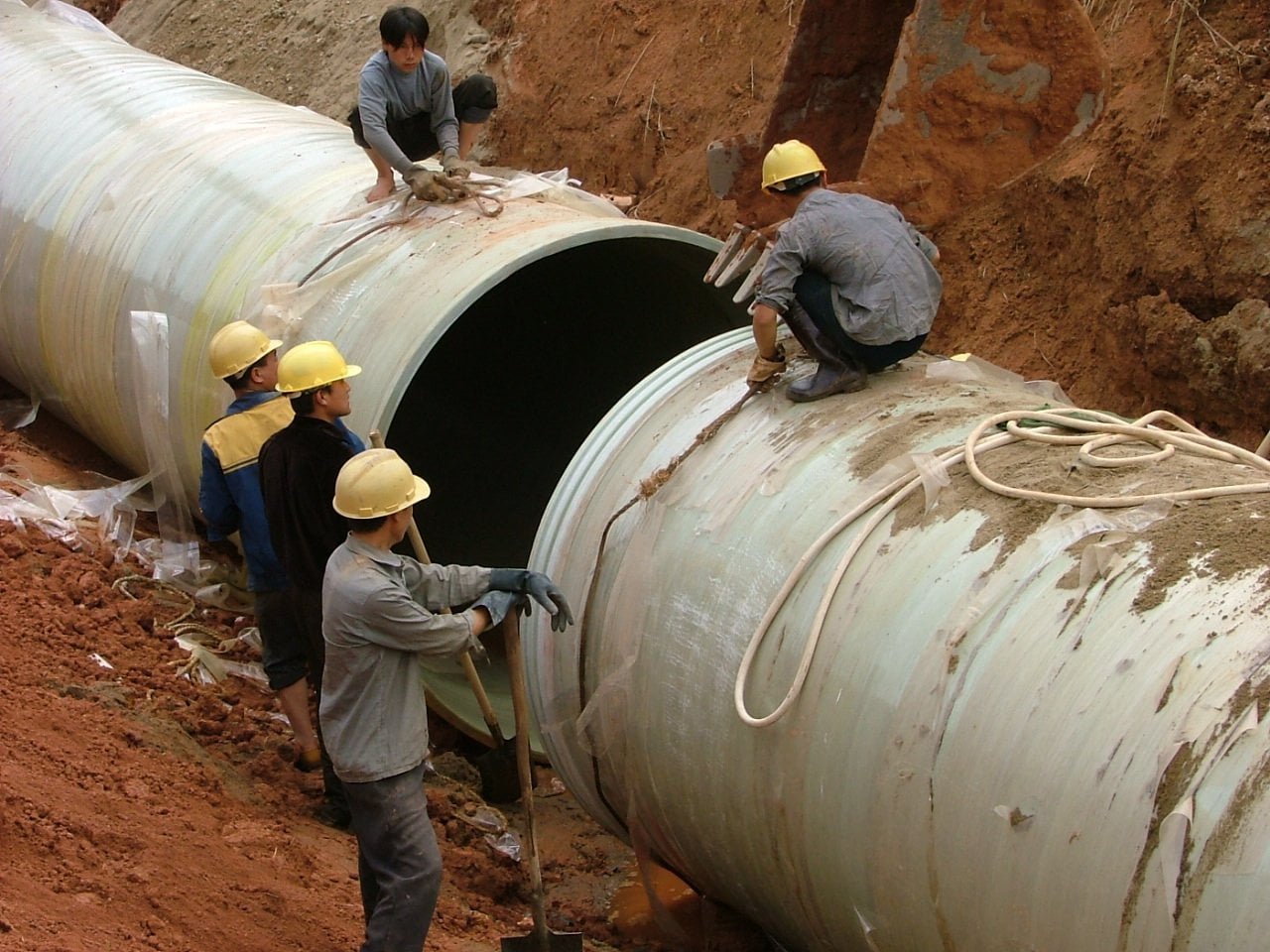
Among the numerous composite material pipelines, there are two types that have emerged as “star players” in modern infrastructure construction due to their unique technical advantages – they are the continuous winding fiberglass reinforced plastic pipelines that can be mass-produced efficiently, and the fiberglass pipe jacks that can “quietly” penetrate through the urban underground.
1. Continuous winding of fiberglass pipes: Building pipes like “weaving cloth”
Imagine that the pipes are not pieced together section by section, but are “woven” continuously like fabric – this is the core of the continuous winding process. It uses automated equipment to wind the resin-impregnated glass fibers at precise angles onto a rotating core mold, and after curing, forms a seamless continuous pipe body.
The three major breakthroughs of this technology:
1. Efficiency and quality in harmony
• The production line can operate non-stop for 24 hours, and the daily output of pipelines can reach several hundred meters.
The fully computer-controlled system eliminates human errors, ensuring that the wall thickness and strength of each section of pipe are exactly the same.
• With diameters ranging from 300mm to 4000mm, it can meet various demands, from community water supply to large-scale water diversion projects.
2. Perfect balance of performance
• Robust yet lightweight: The compressive strength is comparable to that of steel, yet its weight is only 1/4 of that of steel pipes. No heavy equipment is required during hoisting.
• Unobstructed: The inner wall is extremely smooth, and it will not accumulate dirt even after long-term use. Its conveying capacity is 10% – 15% higher than that of the same-sized cement pipes.
• Resistant to corrosion: It can safely transport substances for decades, whether they are acidic industrial wastewater or salty seawater.
3. Remarkable economic benefits
• Although the unit price may be slightly higher than that of traditional pipelines, the 50-year maintenance-free feature has reduced the total life cycle cost by over 30%
The installation speed is 40% faster than that of traditional pipelines, significantly reducing the construction period.
It is transforming these fields:
• Long-distance water diversion projects: Projects with a water diversion distance of over 100 kilometers. The lightweight nature of the continuous spiral pipes can significantly reduce transportation and installation costs.
• Industrial park pipeline network: For the transportation of corrosive media by enterprises such as chemical and electroplating industries, traditional metal pipes need to be replaced every 1-2 years, while glass fiber pipes can be maintained for over 20 years.
• Deep-sea discharge pipeline: Resistant to seawater corrosion and microorganism adhesion, it has become the preferred choice for sewage pipelines on the seabed in coastal cities.
II. Fiberglass Reinforced Plastic Pipe Joints: The Cutting-edge Tool for Conducting “Minimally Invasive Surgery” in Cities
When pipelines need to pass through busy roads, existing buildings or historical districts, fiberglass pipe jacking offers the best solution – it enables the pipeline laying to be carried out with great precision and minimal impact.
The unique advantages of pipe jacking construction:
1. The “non-invasive” wisdom
• Just operate in the working well and receiving well, and the pipeline is advanced section by section underground.
It will not in any way affect ground transportation, business operations or the daily lives of residents.
• The earthwork volume has been reduced by 80%, eliminating the need for extensive land acquisition.
2. Design for advancement
• The pipe opening has been specially reinforced to be able to withstand hundreds of tons of thrust without deforming
A waterproof sealing ring is used between the pipe sections, ensuring no leakage even after being pushed through for a distance of one hundred meters at one time.
The outer wall is smooth and durable, and it can also advance smoothly in sandy and rocky strata.
3. Outstanding engineering adaptability
• The minimum soil coverage depth is only 2.5 meters, making it particularly suitable for urban areas where there is a shortage of shallow underground space.
• Capable of curved tunneling to bypass underground obstacles
The construction speed can reach 20-50 meters per day, which is 2-3 times that of traditional excavation and laying methods.
These scenarios cannot be achieved without it:
• “Minimally invasive” urban renewal surgery: Updating the underground pipelines without damaging the old city’s appearance
• River crossing project: Traditional cofferdam construction would affect shipping and the environment. The pipe jacking technology only requires construction on both banks.
• Beneath the transportation hubs: Safely lay down pipelines beneath sensitive areas such as subway stations and high-speed railway stations.
• Emergency rescue project: Quickly restore the damaged pipeline to avoid prolonged road closures
How to choose the appropriate pipe?
Choose continuous coiled pipes when you need:
• Long-distance straight-line laying
High flow rate and stable transportation
• Control the total life cycle cost
Rapid construction and commissioning
Choose fiberglass pipe jacking. When you encounter:
• Crossing important buildings or major transportation routes
Construction restrictions in environmental protection areas
• The underground space is complex and full of obstacles.
• Require minimizing the social impact
These two types of pipes represent two directions of the application of composite materials in engineering: one is to achieve efficient mass production through industrialization to meet the demands of large-scale infrastructure construction; the other is to solve special engineering problems through customized solutions. They are not only innovations in materials but also advancements in engineering thinking – a shift from “how to manufacture good pipes” to “how to make pipes better serve urban development”.
As the development of urban underground space in our country continues to deepen, and the environmental protection requirements for projects keep rising, the application of these two types of “intelligent pipelines” will become more widespread, silently supporting the operation and renewal of the city.
FRP pipes: How two “star products” solve engineering challenges
 hedelong0128@gmail.com